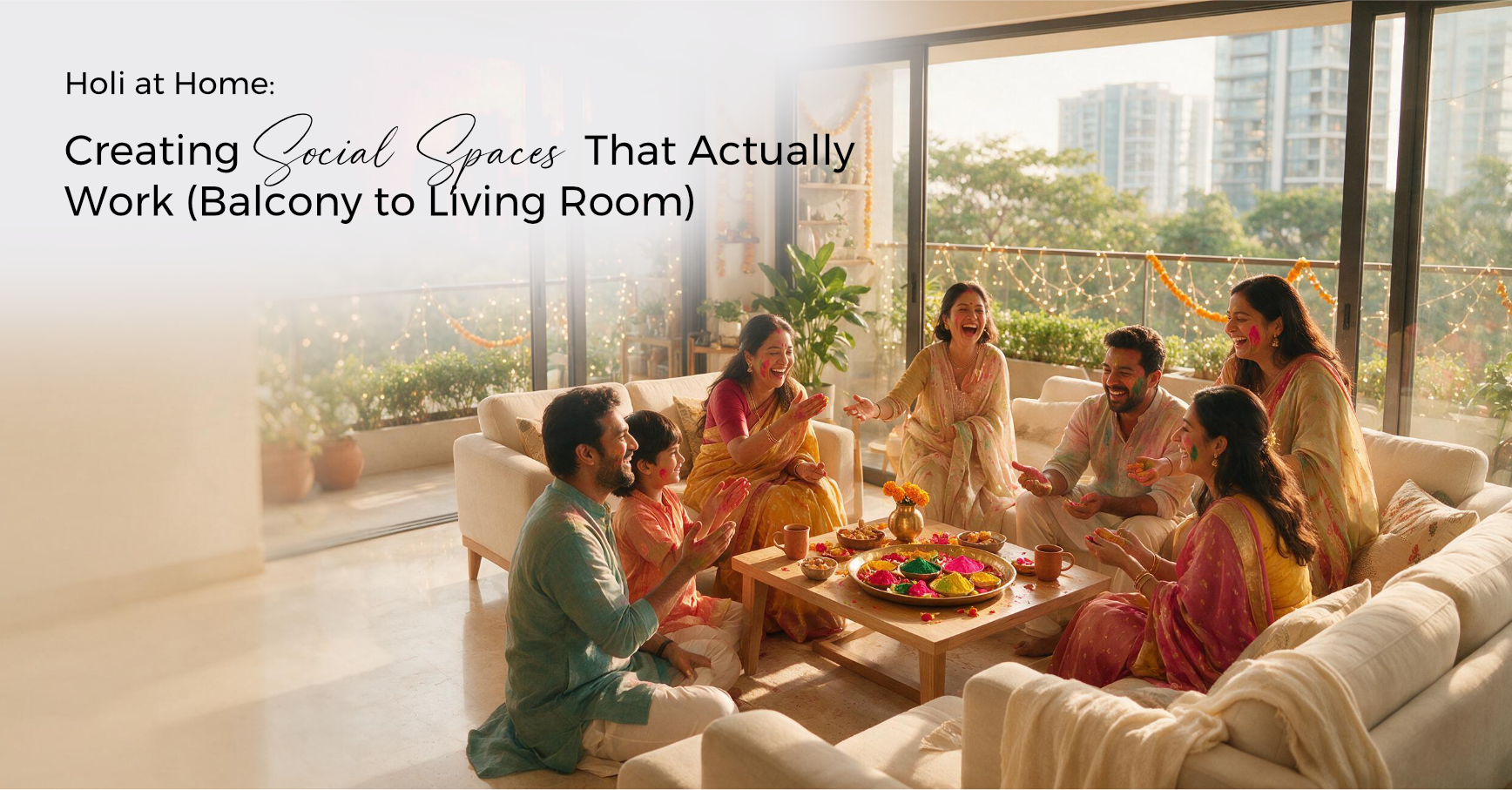
There is a specific kind of joy that arrives when your home holds a celebration without straining at the seams. The living room absorbs the crowd. The balcony becomes the place people drift toward with their drinks. The kitchen keeps pace with the evening without the host disappearing into it for hours. The music carries without needing to be shouted over. The whole thing feels, from inside it, almost effortless.
Holi brings that aspiration into sharp focus. It is a festival that spills outward. Colour, noise, laughter, people arriving in waves and staying longer than planned. A home that handles Holi well is not just a home that is big enough. It is one that has been designed, or arranged, to allow people to move through it freely, gather in clusters, and find their own comfortable corner within the celebration.
This is a guide to understanding what makes a social space genuinely work, from the balcony to the living room, and what to look for when choosing a home that holds that possibility.
The Balcony: More Than a View
A balcony that is wide enough for two chairs and a small table is a storage space waiting to happen. A balcony that is deep enough for six people to stand comfortably, or seat four around a table, is a room that exists outdoors. The difference in how a home feels during a festival is significant.
During Holi, the balcony earns its place immediately. It is where colour play begins before people come inside. It is where people step out to recover from the noise. It is where the early morning chai happens before the celebrations begin. A generous balcony with a railing that is easy to clean and a floor surface that handles colour and water without drama is, in the context of a festival home, close to essential.
When evaluating apartments with large balconies in Bengaluru, measure the usable depth, not just the stated area. A long, narrow balcony and a square balcony may have the same square footage but will host a gathering very differently.
The Living Room: Flow Over Furniture
The living room is where most of the indoor celebrating happens. And the single thing that determines whether it works for a group is not size alone but flow. Can people move through it without navigating around furniture? Are there natural clusters where conversations can form without the whole room needing to listen? Is there a wall or corner where a table of food and drinks can sit without blocking the room’s movement?
A living room with a single large sofa arrangement in the centre often collapses into a formal setup that nobody quite relaxes in during a party. A living room with a more open centre, seating arranged toward the walls, and a clear sightline to the balcony or dining space allows the energy of the gathering to move naturally.
For buyers considering spacious flats in Bengaluru, look at the living room floor plan carefully. A room that is wide rather than long gives more furniture flexibility. A room with a direct connection to the balcony effectively doubles its capacity for a celebration like Holi.
A Checklist for Homes That Host Well
Before the next Holi, walk through your current or prospective home with these questions.
- Can at least twelve people stand in the living and dining area without it feeling crowded? This is the practical threshold for a mid-sized gathering. If the answer is no, look at whether the balcony and dining room can be integrated into the hosting space.
- Does the living room connect directly to the balcony? A sliding or folding door that opens the living room fully to the balcony is the simplest way to expand a social space without changing a single wall.
- Is the kitchen open-plan or at least partially visible from the living area? An open kitchen means the host stays part of the gathering while cooking or plating. A closed kitchen can feel isolating during a party.
- How many bathrooms does the flat have? During Holi specifically, this matters more than usual. Multiple bathrooms mean guests can clean up without a queue forming and the celebration stalling.
- Is there a utility area or service entrance for post-celebration cleanup? Holi leaves colour on surfaces, clothes, and floors. A home with a utility balcony or service entrance makes the cleanup far less disruptive to the rest of the flat.
- What are the flooring materials in the main social areas? Vitrified tiles and polished stone clean up far more easily than porous surfaces. This is a small detail with a large practical impact on festival hosting.
- Does the society allow Holi celebrations in common areas? Many gated communities have designated areas for colour play. This shifts the outdoor celebration to a shared space and keeps the flat itself easier to manage.
The Open Kitchen: Where the Host Stays in the Room
There is an old problem with closed kitchens and hosting. The person doing the most work is also the most removed from the gathering. They emerge periodically with food and disappear again. The party happens around an absence.
An open or semi-open kitchen solves this quietly. The counter becomes a surface where guests gravitate. The cook is part of the conversation. Drinks and snacks circulate naturally because everyone can see where they are. During a festival like Holi, where the energy of the room is part of the celebration, this matters more than most buyers anticipate when viewing a property.
Many modern apartments in Bengaluru are now designed with open or island kitchen layouts that integrate the cooking space into the social heart of the home. If this style of hosting matters to you, it is worth making it a non-negotiable on your site visit list.
Common Areas and the Society’s Role in Festival Hosting
For apartment residents, Holi is increasingly a shared experience that begins in the building’s common areas. A well-maintained podium, a landscaped courtyard, or a clubhouse lawn that the society opens up for colour celebrations can transform the festival experience for everyone in the building.
Children have a proper outdoor space to play. Adults can celebrate with neighbours without worrying about the flat. Cleanup is managed collectively. The festival feels, as it is meant to, like a community event rather than something contained and slightly anxious inside four walls.
When considering gated community apartments in Bengaluru, ask the developer how the society handles festival celebrations. The answer tells you a great deal about the kind of community the building is likely to become.
What Mantri Builds Into Social Space Design
Mantri Developers has spent decades understanding how families in Bengaluru actually use their homes. Festivals, gatherings, multi-generational celebrations, and the daily rhythms of a full household are all part of what shapes a Mantri floor plan. That experience shows in the details that matter most when a home needs to hold a crowd.
From balconies with real depth to living rooms designed for movement rather than just furniture placement, and common areas that bring the community together, Mantri projects are built with the understanding that a home’s best moments happen when people gather in it. If you are exploring homes for entertaining in Bengaluru, the social design of a Mantri project is worth experiencing in person.
After the Colour: Homes That Are as Easy to Clean as They Are to Celebrate In
The best Holi celebration ends with an easy cleanup. A home designed for this reality has surfaces that wipe clean, bathrooms that can handle volume, a utility space that catches the worst of it, and a layout that does not require the entire flat to be turned upside down to restore order.
This is not a small consideration. A home that is genuinely easy to live in after a celebration is one that invites the celebration in the first place. If the cleanup feels like a week-long project, the instinct to host starts to fade. A well-designed home keeps the joy intact on both sides of the party.
A Home That Says Yes to the Festival
Holi is not a quiet festival. It asks things of a home. Outdoor space for colour. Indoor space for people. A kitchen that keeps up. Bathrooms that handle the rush. A layout that lets the energy of the day move freely rather than pile up in one corner.
The best homes say yes to all of it, not by being the largest on the floor, but by being designed with the fullness of a family’s life in mind. Mantri Developers builds with that fullness as the brief. If you are searching for a home in Bengaluru that hosts beautifully, look for the balcony with real depth, the living room that breathes, and the community that celebrates together. That home will make every Holi feel the way it should.